
On the 9th of July 2026, the Building Safety Regulator announced plans to introduce a more proportionate, targeted and risk-based approach to Building Assessment Certificates for occupied higher-risk buildings in England.
The announcement followed confirmation from the regulator, that assessments were taking approximately twice as long as originally anticipated and that 66% of applications submitted so far in 2026 had been refused.
What is a Building Assessment Certificate?
A Building Assessment Certificate confirms that, at the time of an assessment, the Building Safety Regulator was satisfied that the Principal Accountable Person was complying with certain duties under Part 4 of the Building Safety Act 2022.
The certificate itself is issued by the Building Safety Regulator.
When directed to apply, the Principal Accountable Person must submit an application supported by documents including:
- The building’s safety case report
- Its resident engagement strategy
- Information about its mandatory occurrence reporting system
The application must normally be submitted within 28 calendar days of the Building Safety Regulator’s direction. A Building Assessment Certificate represents a snapshot of compliance at the time of the assessment. It is not, by itself, a guarantee that the building will remain safe or compliant in the future.

Which buildings are affected?
The Building Assessment Certificate regime applies to occupied higher-risk buildings in England. A building will generally fall within the regime where it:
- Is at least 18 metres in height or has at least seven storeys and,
- Contains at least two residential units.
The legislation includes detailed rules for measuring buildings and identifying separate structures or sections of connected buildings.
Our experience of the Building Assessment Certificate process
Jennings & Barrett manages a number of higher-risk buildings and supports the relevant Principal Accountable Persons and Accountable Persons with their Building Safety Act responsibilities.
To date, the Principal Accountable Persons for two developments managed by Jennings & Barrett have been directed to apply for Building Assessment Certificates. Our experience of the process has identified a number of practical difficulties, including:
- Lengthy delays in receiving substantive responses or decisions from the Building Safety Regulator.
- Uncertainty regarding the level and form of evidence expected within some parts of an application.
- Difficulty locating historic building information created before our appointment or, in some cases, before the current management company was established.
- Challenges ensuring that government guidance is interpreted and applied consistently.
- Significant demands being placed on volunteer resident directors who may not have technical building safety experience.
- Increased professional, administrative and regulatory costs.
- Limited availability of appropriately experienced fire, structural and building safety specialists.
- Difficulty obtaining consistent advice from third-party providers.
- The need to reconcile urgent building safety requirements with leases, procurement obligations, service charge consultation requirements and company decision-making procedures.
Historic information can be relevant to the safety case for a building, including information about its original construction, structural history, alterations and previous remediation works. Where historic information is missing, Accountable Persons are expected to make reasonable enquiries to locate it and explain the steps taken where it cannot be obtained.
Our concern is not that historic information is irrelevant. It is that the practical difficulty and cost of reconstructing incomplete records have not always been adequately recognized within the process.
Our concerns about implementation
In our experience, implementation of the Building Assessment Certificate regime has:
- Created a substantial additional demand on the resources of managing agents and their clients.
- Placed significant statutory responsibilities and potential liabilities on Principal Accountable Persons and Accountable Persons.
- Increased ongoing professional and compliance costs.
- Resulted in additional costs being passed to some leaseholders and residents.
Some ongoing Building Safety Act compliance costs may be recoverable through service charges, depending on the terms of the lease and the applicable statutory requirements.
These ongoing compliance costs should be distinguished from historic remediation costs, which may be subject to separate leaseholder protections.
Jennings & Barrett supports the objectives of the Building Safety Act 2022. However, at the developments we manage, we are concerned that the administrative burden and expenditure associated with the Building Assessment Certificate process have not yet been matched by sufficiently clear or measurable improvements in building safety outcomes.
What issues has the Building Safety Regulator identified?
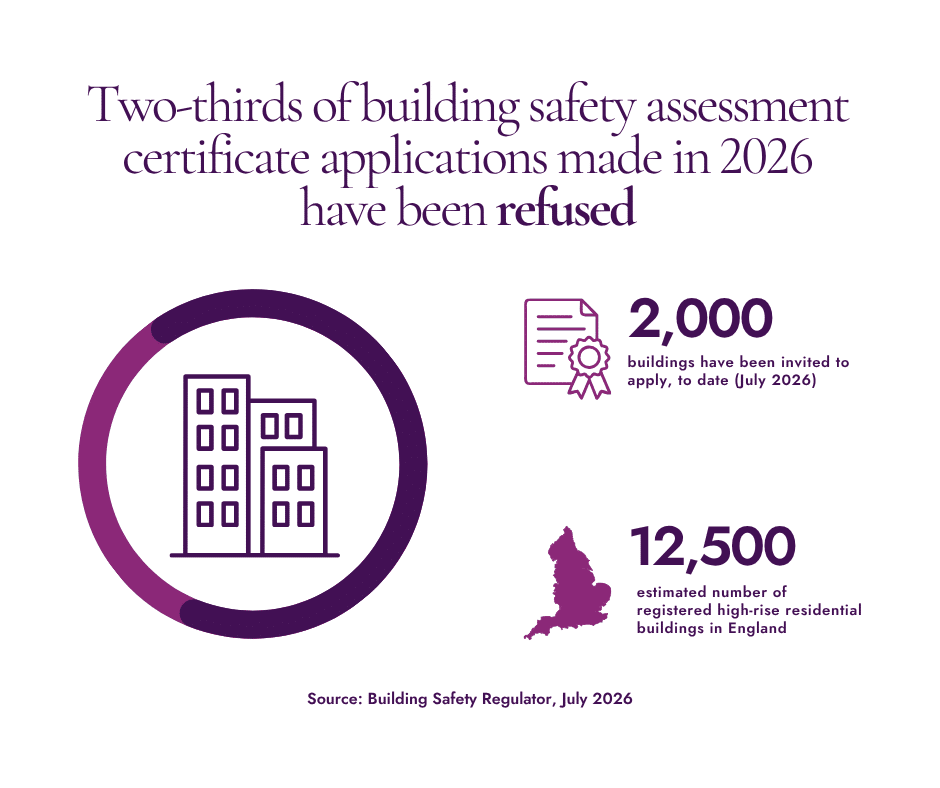
The Building Safety Regulator reports that 66% of applications made in 2026 have been refused.
They have also confirmed that assessments are taking approximately twice as long as originally anticipated.
It has identified a number of recurring issues with applications, including:
- Applications focusing on procedural compliance rather than demonstrating how building safety risks are being managed effectively.
- Applications failing to demonstrate adequate arrangements for managing the risks of fire spread and structural failure.
- Volunteer-led Resident Management Companies, Right to Manage companies and commonhold organisations finding the legal requirements particularly difficult to navigate.
- Additional or unforeseen costs being passed to residents.
These findings do not necessarily contradict our own experience.
In our view, refused applications, missing historic information, unclear expectations, limited professional capacity and regulatory delays are different parts of the same implementation challenge.
What is the Building Assessment Certificate foundation plan?
The Building Safety Regulator refers to its proposed package of reforms as the Building Assessment Certificate foundation plan.
The future assessment process and timetable have not yet been finalized. During the transition, the regulator has said that it intends to:
- Prioritize applications that are already undergoing assessment.
- Direct new applications only where necessary until improved processes have been agreed and communicated.
- Explore proportionate and accelerated reassessments for previously refused applications once the required standards have been met.
- Provide more targeted support to resident-led Principal Accountable Persons.
- Review the impact of the regime, including costs passed to leaseholders, with the Ministry of Housing, Communities and Local Government.
A more intelligence-led and risk-based approach
The Building Safety Regulator has said that the revised approach will include:
- Initially concentrating on organisations responsible for multiple higher-risk buildings.
- Carrying out sample interventions based on risk or intelligence relating to buildings, organisations or duty holders.
- Giving smaller, volunteer-run resident management companies more time to prepare their evidence.
- Supporting applicants whose applications are currently being processed, as well as applicants whose applications were previously refused and who have been given building-safety actions to complete.
The regulator has also said that it is exploring proportionate, fast-tracked reassessments for previously refused applications.
Additional support for duty holders
The Building Safety Regulator has announced that it intends to provide greater support to duty holders through:
- Simplified assessment criteria to make expectations clearer for applicants and assessors.
- Clearer technical guidance, developed with professional bodies, explaining what constitutes a suitable structural and fire risk assessment.
- A single point of contact for Principal Accountable Persons responsible for multiple higher-risk buildings, including local authorities, housing associations and larger landlords.
- Possible pre-application advice and support through a named Building Safety Regulator contact for resident-managed buildings.
- Information that duty holders can provide to residents explaining the assessment process.
Initial updated resources are expected to become available from September 2026, with further support to follow.
What should Principal Accountable Persons and Accountable Persons do now?
The legal duties of Principal Accountable Persons and Accountable Persons remain in force. Duty holders should not wait for a future Building Assessment Certificate assessment before continuing to:
- Prepare and maintain the building’s safety case report.
- Operate an effective mandatory occurrence reporting system.
- Implement and review the resident engagement strategy.
- Maintain the golden thread of building information.
- Take reasonable steps to prevent and mitigate building safety risks.
Principal Accountable Persons and Accountable Persons may appoint a managing agent or other competent provider to undertake work on their behalf. However, their statutory duties, accountability and liability cannot be transferred to the managing agent.
See the list of duties for PAP and AP here.

How Jennings & Barrett can assist
Jennings & Barrett is continuing to ask clients who are Principal Accountable Persons or Accountable Persons to provide the formal instructions and authority required for us to deliver the agreed higher-risk building services on their behalf.
Further information is available through our resident engagement resources:
Watch our Building Safety Webinar
Clients with queries about their building safety management can email buildingsafety@sienna-buffalo-255343.hostingersite.com to reach our Compliance staff.
Looking for support with higher-risk building management?
Compliance is complex – but our professional advice provides clarity and direction.